 Ethena
Ethena unstaking ties token withdrawals to the applicable vault cooldown
Ethena unstaking converts staked vault shares into underlying tokens and releases them after the applicable cooldown. For sUSDe, the vault fixes a USDe amount when the cooldown starts; withdrawal follows once the recorded deadline allows it. Selling sUSDe through an available market follows a separate route, with proceeds determined by liquidity and execution terms.
sUSDe and sENA represent different underlying assets, so their withdrawal balances and timers need separate treatment. Additional token locks can introduce another waiting period. The token shown as withdrawable determines whether an action releases USDe, ENA, or a staked receipt.
In short: A successful sUSDe cooldown request fixes the pending USDe amount, while a later claim transfers that amount to the receiver.
Vault participation and reward entitlement
Holding sUSDe represents participation in Ethena’s USDe staking vault and entitlement to its vested assets. The vault incorporates distributed rewards into the USDe value of each share. A withdrawal therefore uses the shares being redeemed and their asset value at conversion. Distributions remain discretionary; changes in funding rates can affect protocol revenue without creating a fixed withdrawal reward. Reward transfers vest gradually, so the conversion value reflects rewards that have vested.
The staking interface serves users in permitted jurisdictions. Acquisition of sUSDe is not offered to people habitually resident, or entities with registered offices, in the European Union or European Economic Area. Holding an asset does not establish eligibility for every interface or staking operation.
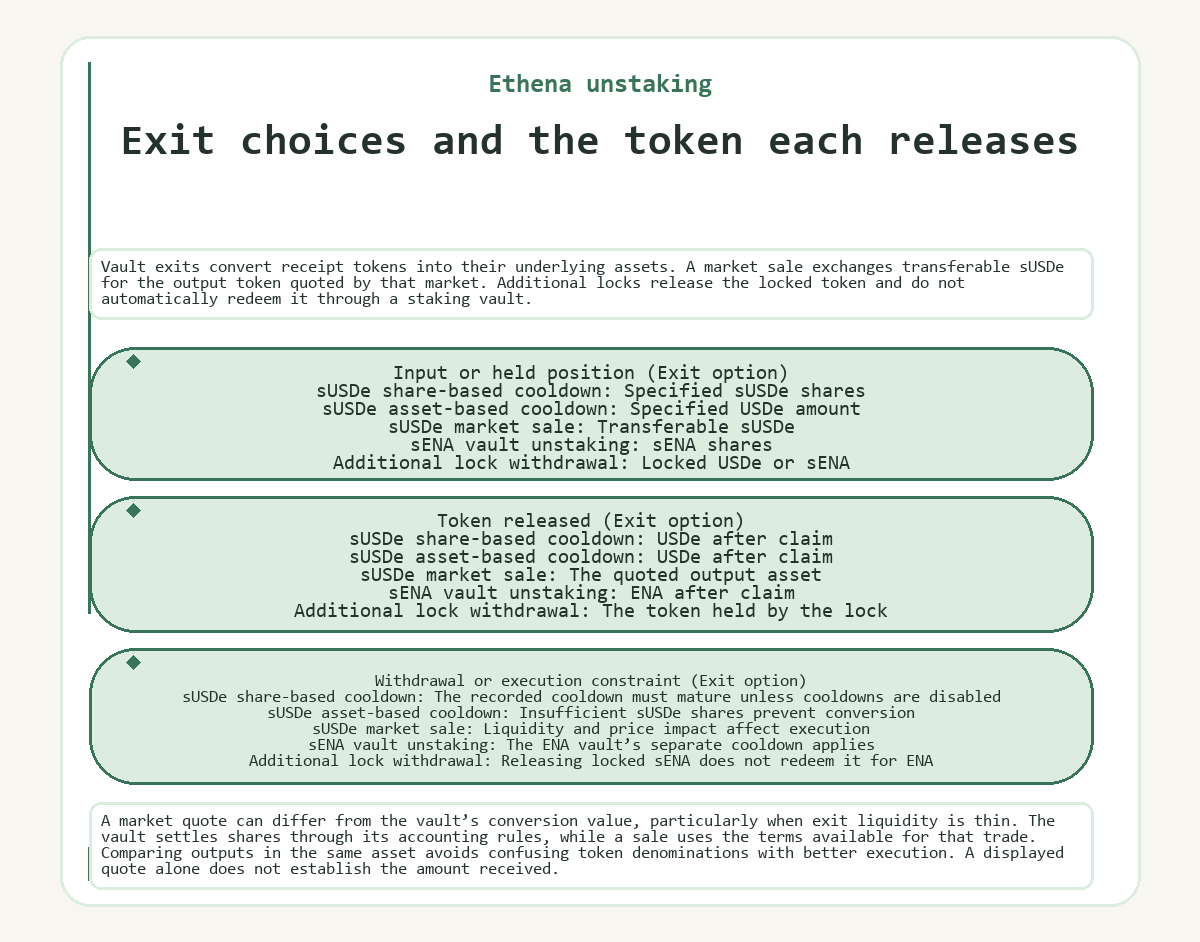
Exit choices and the token each releases
Vault exits convert receipt tokens into their underlying assets. A market sale exchanges transferable sUSDe for the output token quoted by that market. Additional locks release the locked token and do not automatically redeem it through a staking vault.
| Exit option | Input or held position | Token released | Withdrawal or execution constraint |
|---|---|---|---|
| sUSDe share-based cooldown | Specified sUSDe shares | USDe after claim | The recorded cooldown must mature unless cooldowns are disabled |
| sUSDe asset-based cooldown | Specified USDe amount | USDe after claim | Insufficient sUSDe shares prevent conversion |
| sUSDe market sale | Transferable sUSDe | The quoted output asset | Liquidity and price impact affect execution |
| sENA vault unstaking | sENA shares | ENA after claim | The ENA vault’s separate cooldown applies |
| Additional lock withdrawal | Locked USDe or sENA | The token held by the lock | Releasing locked sENA does not redeem it for ENA |
A market quote can differ from the vault’s conversion value, particularly when exit liquidity is thin. The vault settles shares through its accounting rules, while a sale uses the terms available for that trade. Comparing outputs in the same asset avoids confusing token denominations with better execution. A displayed quote alone does not establish the amount received.
How long must an sUSDe withdrawal wait?
An sUSDe withdrawal becomes claimable when its stored cooldown end arrives, unless the vault has disabled cooldowns. The vault’s cooldownDuration supplies the waiting period for a new request. The contract adds that duration to the successful request’s block timestamp to record cooldownEnd. Governance can adjust the configured period as the liquidity of USDe’s backing assets changes, so one historical duration cannot describe every withdrawal.
An existing request retains its stored deadline when governance changes the duration to another nonzero value. If the global cooldown becomes zero, the deployed sUSDe contract permits claims from the silo without waiting for that deadline. At contract level, zero duration also enables direct withdraw and redeem calls for shares still held, while disabling cooldown initiation.
An additional cooldown request from the same wallet adds USDe to its pending balance and replaces the end timestamp. The new timestamp governs the accumulated balance, including amounts that entered earlier. Splitting an exit into repeated requests can therefore delay the earlier portion.
Share conversion and USDe held in the silo
On Ethereum, StakedUSDeV2 handles conversion and records the pending balance, while USDeSilo holds the corresponding underlying tokens. The sUSDe balance can decrease before the wallet receives USDe because those operations occur at different stages.
Amount selection at conversion
The vault accepts requests in either share units or underlying token units. Both choices reach the same cooldown mechanism, but they fix different sides of the conversion. Conversion previews only read the vault’s state; a successful cooldown request commits the share burn.
A specified sUSDe share amount
cooldownShares takes a share quantity and uses previewRedeem to calculate its USDe equivalent. The calculation uses the vault’s vested assets and outstanding shares, with rounding down to the underlying token’s smallest unit.
A specified USDe amount
cooldownAssets takes the USDe quantity to reserve and uses previewWithdraw to calculate the shares to burn. This asset-denominated method rounds the required share quantity upward, so an asset amount and a share amount are not interchangeable inputs.
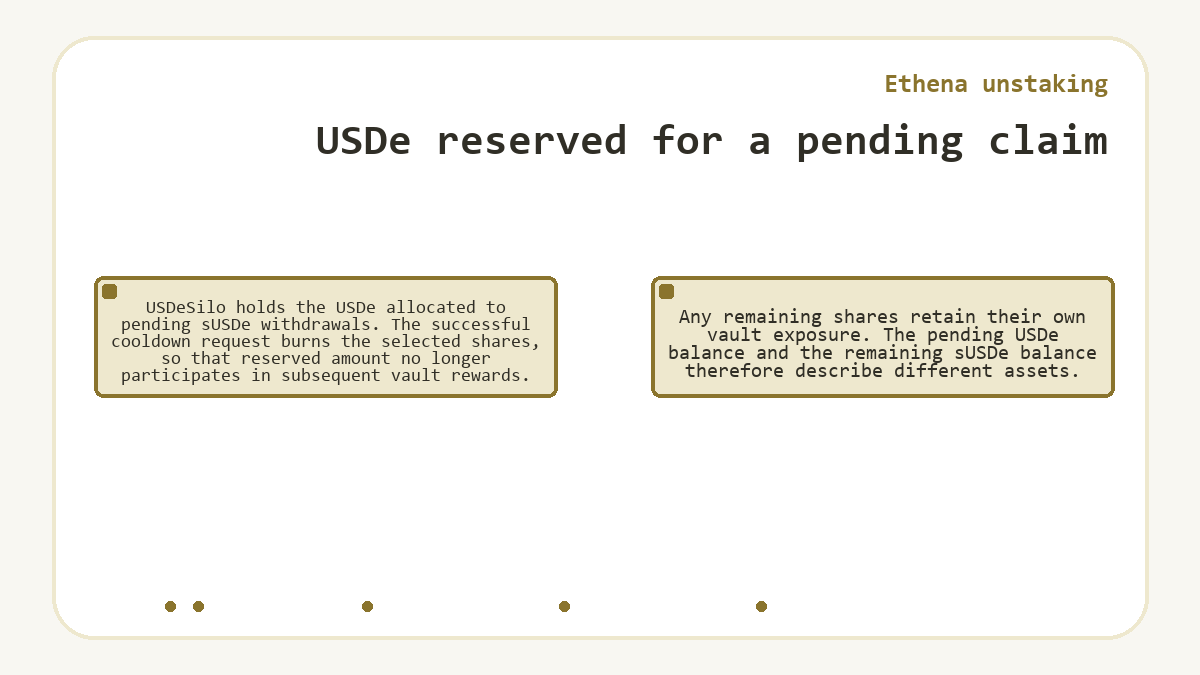
USDe reserved for a pending claim
USDeSilo holds the USDe allocated to pending sUSDe withdrawals. The successful cooldown request burns the selected shares, so that reserved amount no longer participates in subsequent vault rewards. Any remaining shares retain their own vault exposure. The pending USDe balance and the remaining sUSDe balance therefore describe different assets.
sENA unstaking and additional token locks
sENA unstaking redeems shares of the ENA staking vault and ultimately releases ENA. Its cooldown configuration belongs to that vault, so the sUSDe parameter does not determine its withdrawal time.
The ENA vault
StakedENA uses share accounting and configurable reward vesting. ENA distributions to the vault are discretionary, so a receipt token alone does not promise continuing rewards. The withdrawal amount reflects the underlying ENA attributable to the shares. A dollar-denominated balance estimate does not change the token that the vault releases.
Additional token locks
A separate incentive lock can hold USDe or sENA before the locked tokens become available. A successful unlock request starts the lock’s withdrawal period. After that period, a successful withdrawal transaction releases the locked token. For a locked sENA position, that release produces sENA. Converting it into ENA involves the staking vault’s separate unstaking requirements.
LP-token locks have their own rules, and some permit immediate withdrawal. Their release returns the liquidity-position token, without automatically redeeming shares in either staking vault.
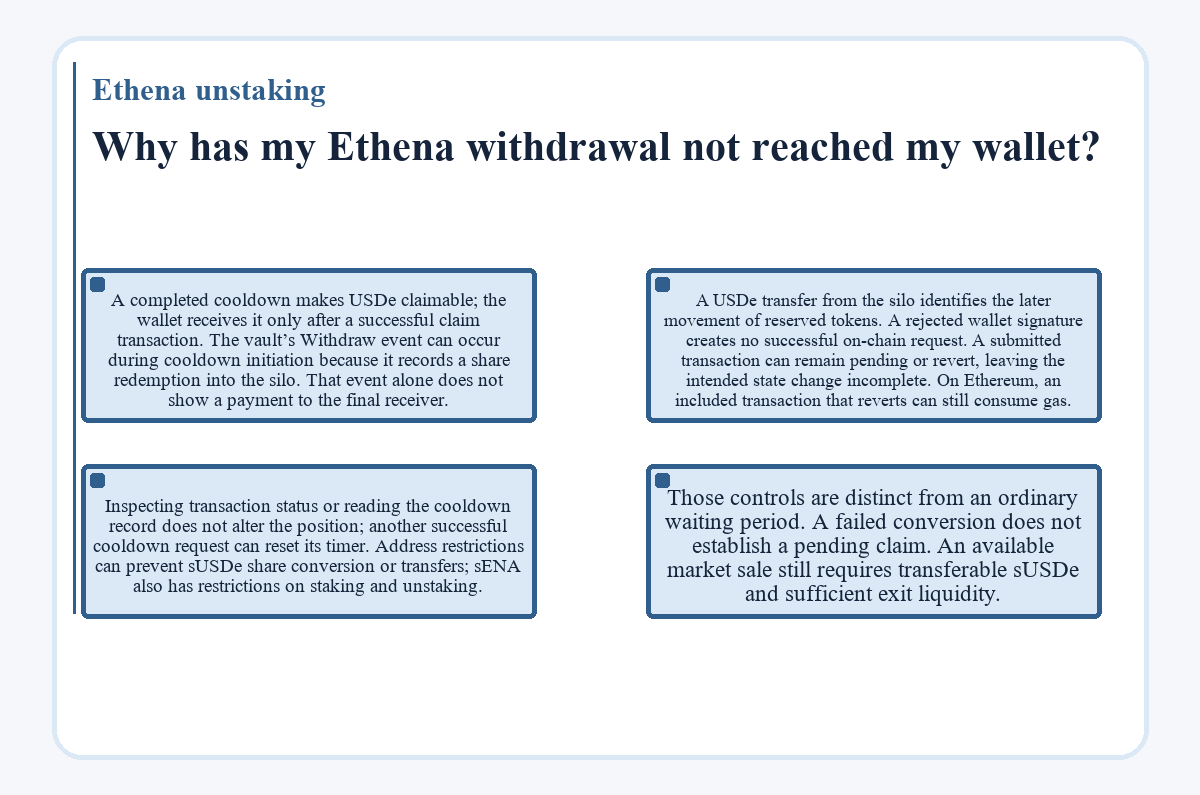
Why has my Ethena withdrawal not reached my wallet?
A completed cooldown makes USDe claimable; the wallet receives it only after a successful claim transaction. The vault’s Withdraw event can occur during cooldown initiation because it records a share redemption into the silo. That event alone does not show a payment to the final receiver. A USDe transfer from the silo identifies the later movement of reserved tokens.
A rejected wallet signature creates no successful on-chain request. A submitted transaction can remain pending or revert, leaving the intended state change incomplete. On Ethereum, an included transaction that reverts can still consume gas. Inspecting transaction status or reading the cooldown record does not alter the position; another successful cooldown request can reset its timer.
Address restrictions can prevent sUSDe share conversion or transfers; sENA also has restrictions on staking and unstaking. Those controls are distinct from an ordinary waiting period. A failed conversion does not establish a pending claim. An available market sale still requires transferable sUSDe and sufficient exit liquidity.
Popular questions about Ethena unstaking
Can I send claimed USDe to a different wallet?
The sUSDe unstake function accepts a receiver address for the USDe payout. The transaction caller must be the address with the pending cooldown balance. Specifying another receiver does not transfer control of that pending claim.
Is a separate reward claim necessary before unstaking sUSDe?
sUSDe vault rewards form part of the share conversion value, so they do not require a separate reward claim. The conversion includes rewards that have vested into the assets backing those shares.
Which costs apply to an sUSDe cooldown and claim?
The cooldown request and subsequent claim both require transaction execution, so network gas costs apply. Ethereum fees depend on gas usage and fee conditions when each transaction executes. A market sale can introduce separate trading costs, which are not payments for shortening the vault’s timer.
When does a mature sUSDe claim expire?
The deployed sUSDe claim function sets no upper deadline after cooldown maturity. Waiting longer does not restore the burned shares or add new sUSDe vault rewards to the reserved USDe. The claim remains associated with the initiating address until withdrawal.
Will an sUSDe transfer move a pending cooldown claim?
Transferring remaining sUSDe shares does not move the USDe already recorded in the sender’s cooldown balance. That pending claim belongs to the initiating address. The recipient receives the transferred shares, while the original address retains its separate claim to the reserved USDe.
Can a mature sUSDe claim release only part of its pending USDe?
The deployed unstake function releases the caller’s full recorded USDe balance and does not accept a partial claim amount. Partial share conversion is possible when starting a cooldown, but that is a different operation from dividing an already recorded claim.
What does InvalidCooldown mean when claiming USDe?
InvalidCooldown means the claim reached the sUSDe contract before its stored cooldown end while cooldowns remained enabled. The failed claim does not itself add another cooldown amount or reset that timestamp. An included transaction that reverts can still consume gas.
Does an sUSDe preview prove that withdrawal will succeed?
An sUSDe preview estimates a share-to-asset conversion; it does not confirm transaction execution. ERC-4626 preview methods do not apply every account or withdrawal limit. The selected cooldown mode, available shares, and applicable restrictions still govern whether the request succeeds.